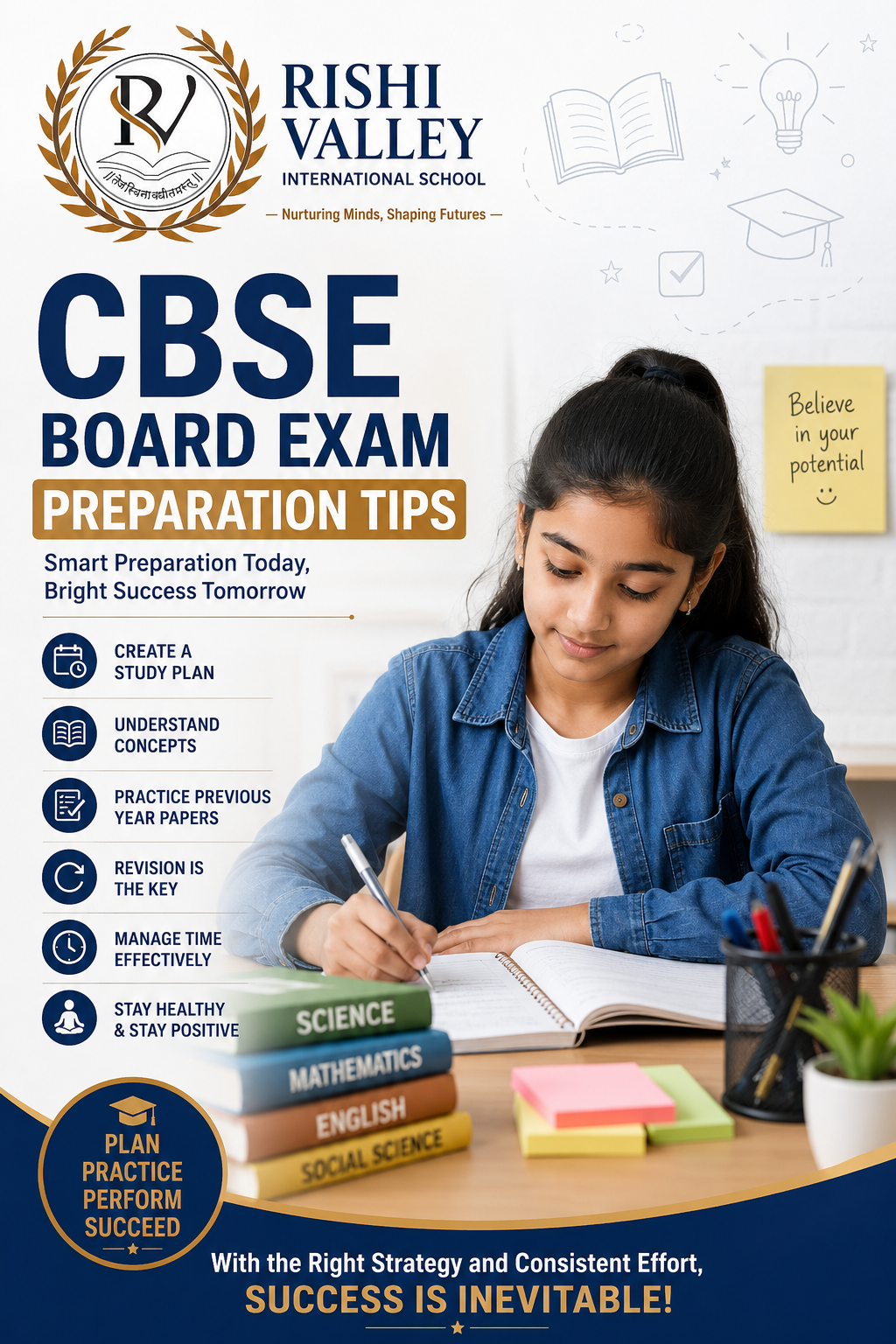
Preparing for board exams can feel challenging, but with the right strategy and consistent effort, every student can perform well. The CBSE Board Exam Preparation Tips shared in this guide will help students study effectively, reduce stress, and improve their confidence before the exams.
At Rishi Valley International School, we believe that success in board examinations comes from smart planning, disciplined learning, and regular practice. Instead of studying for long hours without a plan, students should focus on understanding concepts, revising regularly, and maintaining a healthy routine.
Let’s explore the most effective CBSE Board Exam Preparation Tips that can help students achieve excellent results.
Why Is Proper Board Exam Preparation Important?
Board examinations are an important milestone in every student’s academic journey. They not only determine academic performance but also influence future educational opportunities.
Moreover, effective preparation helps students:
- Improve conceptual understanding
- Build confidence before exams
- Reduce last-minute stress
- Enhance time management skills
- Score higher marks
Therefore, following a structured study plan is essential for success.
1. Create a Realistic Study Timetable
One of the most effective CBSE Board Exam Preparation Tips is creating a practical study schedule.
A good timetable should:
- Allocate equal time for every subject.
- Include short study breaks.
- Reserve time for revision.
- Focus more on weaker subjects.
Most importantly, follow the timetable consistently instead of changing it every day.
2. Understand Concepts Instead of Memorizing
Many students rely only on memorization. However, CBSE examinations increasingly focus on conceptual understanding and application-based questions.
Instead of simply learning answers, try to:
- Understand every concept.
- Learn through examples.
- Relate topics to real-life situations.
- Ask teachers whenever you have doubts.
As a result, concepts stay in your memory for a longer time.
3. Practice Previous Years’ Question Papers
Solving previous years’ papers is among the best CBSE Board Exam Preparation Tips.
Previous papers help students:
- Understand exam patterns.
- Identify important topics.
- Improve writing speed.
- Build confidence.
Additionally, practice solving papers within the actual exam time limit.
4. Revise Every Week
Revision is the key to long-term learning. Without revision, students may forget important concepts before the examination.
An effective revision plan includes:
- Weekly revision sessions.
- Monthly chapter reviews.
- Formula and definition revision.
- Quick revision notes.
Furthermore, regular revision reduces exam anxiety.
5. Focus on NCERT Books
CBSE board examinations are primarily based on NCERT textbooks.
Therefore, students should:
- Read every chapter carefully.
- Solve all exercise questions.
- Revise diagrams and examples.
- Complete in-text questions.
After mastering NCERT, students can use reference books for additional practice.
6. Improve Time Management
Time management plays a major role in board exam success.
Students should:
- Set daily study goals.
- Avoid distractions while studying.
- Divide difficult chapters into smaller sections.
- Use timers for focused study sessions.
Consequently, students complete the syllabus without unnecessary pressure.
7. Take Mock Tests Regularly
Mock tests simulate the actual examination environment.
They help students:
- Improve accuracy.
- Increase speed.
- Identify weak areas.
- Boost confidence.
In addition, reviewing mistakes after every mock test is equally important.
8. Maintain a Healthy Lifestyle
Good health supports better learning and concentration.
Students should:
- Sleep for 7–8 hours daily.
- Eat nutritious meals.
- Drink enough water.
- Exercise regularly.
- Practice meditation or yoga.
A healthy body contributes to a focused mind during exam preparation.
9. Avoid Last-Minute Learning
Many students start learning new topics just before the examination. Unfortunately, this often leads to confusion and unnecessary stress.
Instead:
- Revise important concepts.
- Read summary notes.
- Practice formulas.
- Stay calm and confident.
This approach helps improve performance on exam day.
10. Stay Positive and Motivated
Success begins with a positive mindset.
Students should:
- Believe in their preparation.
- Avoid comparing themselves with others.
- Celebrate small achievements.
- Stay focused on their goals.
Most importantly, confidence improves overall exam performance.
Role of Parents and Teachers
Parents and teachers play an essential role during board exam preparation.
Parents can:
- Create a peaceful study environment.
- Encourage healthy habits.
- Motivate children regularly.
- Avoid unnecessary academic pressure.
Similarly, teachers provide valuable guidance, clarify doubts, and help students strengthen their understanding of important topics.
At Rishi Valley International School, our experienced teachers focus on concept-based learning, regular assessments, doubt-solving sessions, and personalized academic support to help every student perform confidently in CBSE board examinations.
Common Mistakes Students Should Avoid
While preparing for board exams, students should avoid these common mistakes:
- Ignoring NCERT textbooks.
- Skipping revision.
- Studying without a timetable.
- Depending only on guidebooks.
- Losing sleep before exams.
- Spending excessive time on social media.
- Leaving difficult subjects until the last moment.
Avoiding these mistakes can significantly improve exam performance.
Conclusion
Board exams are not just about hard work—they are about smart preparation. Following these CBSE Board Exam Preparation Tips can help students study efficiently, manage their time wisely, and perform confidently in the examination.
At Rishi Valley International School, we encourage every student to develop disciplined study habits, strengthen conceptual understanding, and maintain a positive attitude toward learning. With proper planning, consistent practice, and regular revision, success in CBSE board examinations becomes achievable.
Remember, every small effort you make today brings you one step closer to achieving your academic goals.
Frequently Asked Questions (FAQs)
1. What are the best CBSE board exam preparation tips?
The best tips include creating a study timetable, focusing on NCERT books, solving previous years’ papers, revising regularly, and taking mock tests.
2. How many hours should I study for CBSE board exams?
Quality matters more than quantity. Most students benefit from 4–6 focused study hours daily, along with regular breaks and revision.
3. Are NCERT books enough for CBSE board exams?
Yes. NCERT books form the foundation of the CBSE syllabus. Students should complete them thoroughly before using reference books.
4. How can I reduce exam stress?
Maintain a healthy routine, sleep well, revise regularly, practice yoga or meditation, and stay positive throughout your preparation.
5. Why is revision important for CBSE board exams?
Revision strengthens memory, improves confidence, helps identify weak areas, and increases the chances of scoring higher marks in the examination.