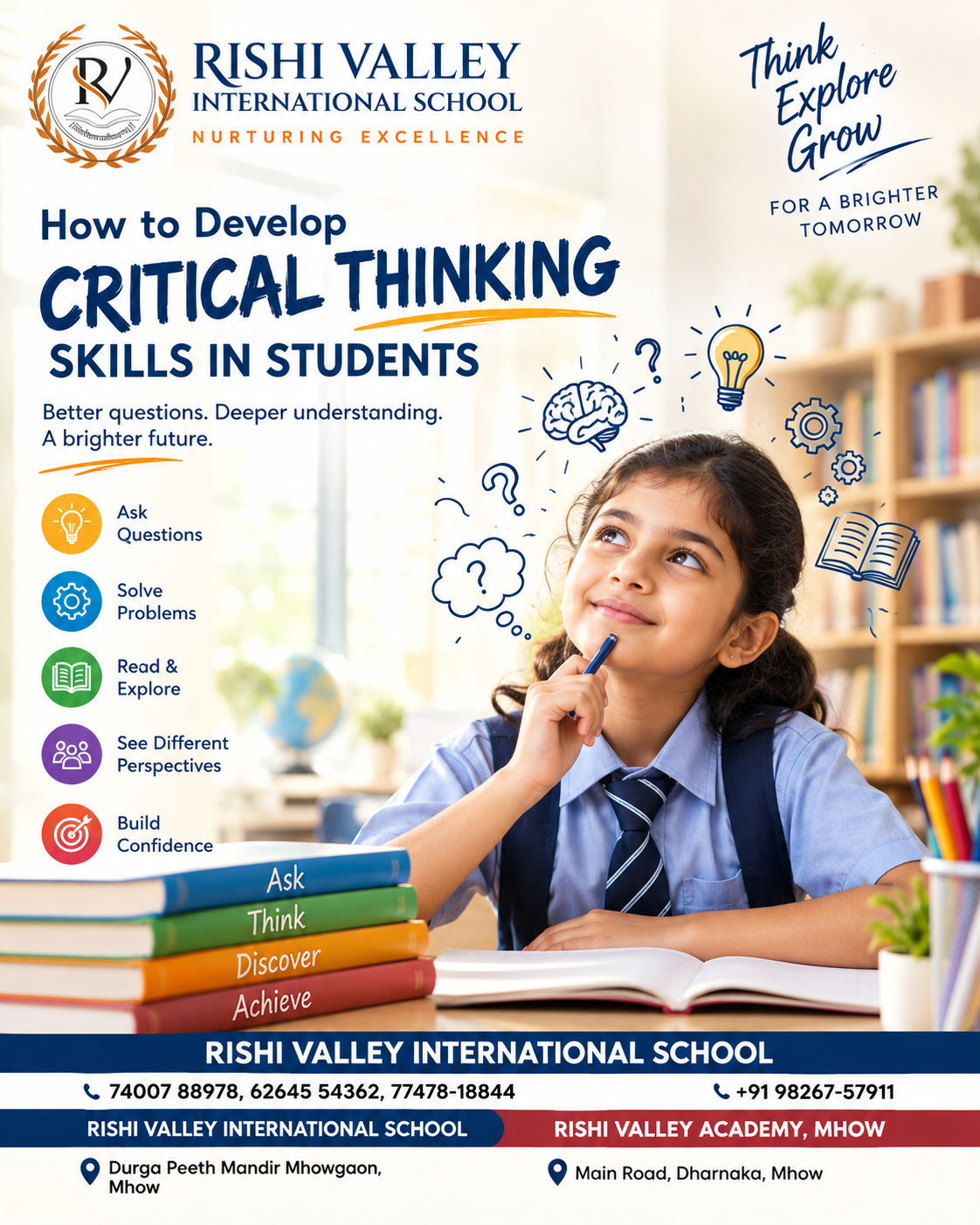
Education is not only about remembering facts or scoring marks in examinations. Students also need to understand information, ask questions, solve problems, and make thoughtful decisions. This is why developing critical thinking skills in students is an important part of modern education.
Critical thinking helps children look at a situation from different perspectives instead of accepting everything immediately. It encourages them to ask why, how, and what if. At Rishi Valley International School, learning is encouraged through curiosity, understanding, and meaningful participation so that students can gradually become confident and independent thinkers.
What Are Critical Thinking Skills?
Critical thinking means carefully examining information before reaching a conclusion. It involves questioning ideas, comparing different viewpoints, identifying reliable information, and using logical reasoning to solve problems.
Developing critical thinking skills in students does not mean teaching them to question everything negatively. Instead, it helps them understand why something is true, consider alternatives, and make decisions based on evidence and reasoning.
These skills are useful not only in academics but also in everyday life, future careers, and personal decision-making.
1. Encourage Students to Ask Questions
One of the simplest ways to develop critical thinking skills in students is to encourage questions.
Instead of giving an immediate answer every time a child asks something, parents and teachers can ask:
- Why do you think this happened?
- What could be another explanation?
- What would happen if we changed something?
- How did you reach that answer?
Such conversations encourage children to think beyond the first answer that comes to mind.
2. Make Learning More Practical
Students understand concepts better when they can connect classroom lessons with real-life situations. Practical activities, experiments, projects, and demonstrations can make learning more meaningful.
For example, instead of only reading about plants, students can observe how plants grow and discuss what happens when sunlight or water is changed. Such experiences naturally strengthen critical thinking skills in students because they encourage observation, comparison, and reasoning.
3. Use Problem-Solving Activities
Puzzles, case studies, brain games, mathematical challenges, and classroom problems can encourage students to find solutions independently.
Teachers can give students a problem and allow them to explore different ways of solving it. The focus should not always be on finding the answer quickly. Understanding how a student arrived at the answer is equally important.
Regular problem-solving activities help strengthen critical thinking skills in students while also improving confidence.
4. Encourage Reading and Discussion
Reading exposes students to different ideas, opinions, cultures, and situations. Encourage children to read age-appropriate books, articles, biographies, and educational material.
After reading, discuss the story or topic with them. Ask what they liked, what they disagreed with, and what they would have done differently.
These conversations help develop critical thinking skills in students because children learn to form opinions and support them with reasons.
5. Teach Students to Look at Different Perspectives
A situation may have more than one point of view. Students can develop stronger reasoning skills when they learn to understand different perspectives.
For example, during a classroom discussion, teachers can divide students into groups and ask them to explain different sides of a topic. This teaches students to listen carefully and understand opinions that may differ from their own.
It is an effective way of building critical thinking skills in students along with communication and listening abilities.
6. Let Students Learn From Mistakes
Mistakes are a natural part of learning. If students are afraid of giving a wrong answer, they may hesitate to participate or experiment with new ideas.
Teachers and parents can instead ask students to examine their mistakes. What went wrong? Which step caused the problem? What could be done differently next time?
This approach turns mistakes into learning opportunities and supports the development of critical thinking skills in students.
7. Encourage Creativity
Critical thinking and creativity can work together. Give students opportunities to create stories, design projects, find alternative solutions, or present their ideas in their own way.
A single problem may have several possible solutions. Allowing students to explore those possibilities helps them become flexible thinkers.
Creative classroom activities can therefore play an important role in developing critical thinking skills in students.
8. Use Technology Responsibly
Technology provides students with access to a huge amount of information, but not everything they see online is accurate. Students should learn to check the source, compare information, and think carefully before accepting something as true.
Teachers can use age-appropriate digital resources to teach students how to distinguish facts from opinions and reliable information from unsupported claims.
This makes critical thinking skills in students particularly valuable in today’s digital world.
How Rishi Valley International School Supports Critical Thinking
At Rishi Valley International School, education focuses on helping students grow academically while developing skills that can support them throughout life. Classroom discussions, practical learning, activities, and opportunities for independent thinking can encourage students to participate actively in their education.
Rather than simply focusing on memorization, meaningful learning experiences can help students understand concepts, ask questions, explore ideas, and develop confidence in their own reasoning.
Conclusion
Strong thinking skills are built gradually through everyday learning experiences. Asking questions, reading, discussing ideas, solving problems, learning from mistakes, and exploring different perspectives can all help develop critical thinking skills in students.
When children are given the freedom to think, explore, and explain their ideas, they become more confident learners. At Rishi Valley International School, encouraging curiosity and independent thinking can help students prepare not only for examinations but also for the challenges and opportunities of the future.
FAQs
1. Why are critical thinking skills important for students?
They help students analyze information, solve problems, understand different perspectives, and make thoughtful decisions.
2. How can parents improve critical thinking at home?
Parents can ask open-ended questions, discuss books and current topics appropriate for the child’s age, encourage problem-solving, and allow children to explain their reasoning.
3. What activities improve critical thinking in children?
Puzzles, experiments, debates, project work, brain games, reading activities, and real-life problem-solving tasks can encourage analytical thinking.
4. Can critical thinking help students academically?
Yes. Understanding concepts, analyzing questions, connecting ideas, and solving problems can support learning across different subjects.
5. What role does school play in developing critical thinking?
Schools can provide opportunities for discussion, practical learning, collaborative projects, experimentation, and independent problem-solving, helping students become more active learners.